How to Automate Your Clinic with AI in 2026
Practical guide to clinic automation: session-note dictation, billing verification, scheduling AI, and HIPAA compliance — from a BCBA who builds these systems.
Healthcare clinics across the United States are discovering the transformative power of AI automation. From streamlining patient intake to optimizing billing processes, AI is helping clinics reduce administrative burden while improving the quality of care. But most clinic automation advice on the internet is written by people who have never sat in a clinician's chair. This guide is different — it walks through practical automation strategies from the perspective of someone who has been both a Board Certified Behavior Analyst seeing clients and a full-stack builder shipping the software that runs behind the scenes. If you run a clinic — ABA therapy, primary care, dental, mental health, or any service-delivery practice — this is for you.
The Hidden Cost of Clinical Admin Work
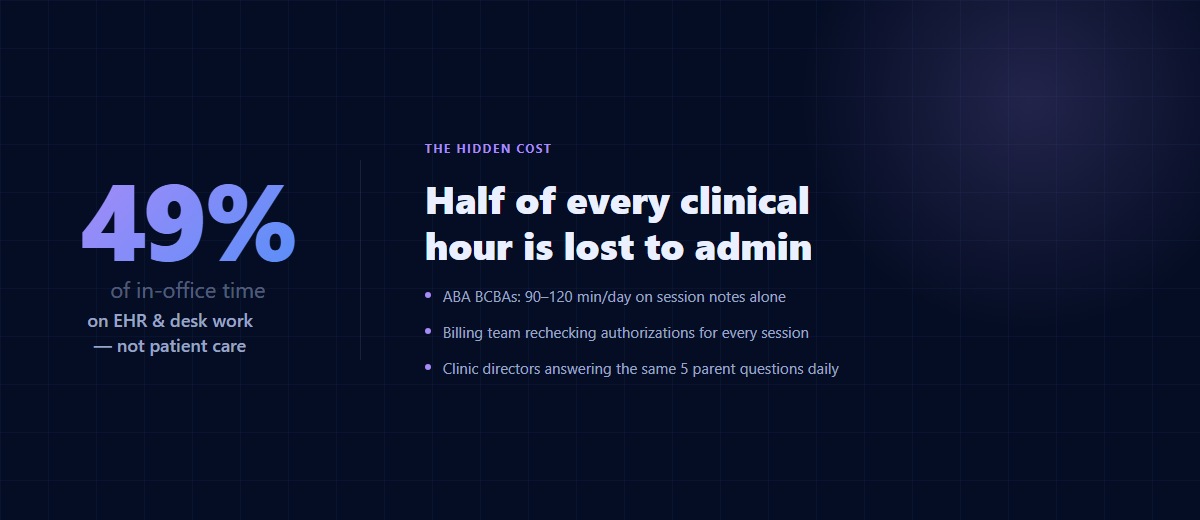
Start with the number that should haunt every clinic owner: clinicians spend 49% of their in-office time on electronic health records and desk work, not direct patient care, according to a 2017 Annals of Family Medicine study that has only been re-confirmed by every subsequent replication. Half of every clinical hour, across specialty after specialty — gone to documentation, orders, inbox management, and billing prep.
The Documentation Burden in Behavioral Health
In the ABA world specifically, the numbers are just as grim. A mid-size ABA clinic's BCBA spends between 90 and 120 minutes a day on documentation alone — session notes, progress reports, authorization requests, supervision reviews. That's before we count the registered behavior technicians writing their own session notes, or the billing team rechecking insurance authorizations, or the clinic director answering the same five parent questions for the twelfth time this week.
Why This Is Really a Retention Issue
I've sat in both chairs — the one running sessions and the one running the practice. Once you've felt the pull of documentation eating into time that should go to the client in front of you, you stop seeing automation as a nice-to-have. It's a clinician-retention issue first and a financial issue second. The real cost of manual clinical admin work isn't the labor hours. It's burnout, turnover, and the slow erosion of why people chose this field in the first place.
That's the frame I want you to hold while we go through the rest of this article. Automation isn't about squeezing more output from your team. It's about giving them their practice back.
Patient Scheduling Automation
One of the most impactful areas for AI automation in clinics is appointment scheduling. AI-powered scheduling systems can handle appointment bookings, send automated reminders that adapt to each patient's communication preferences, manage cancellations and rescheduling, and optimize appointment slots based on provider availability, authorization windows, and historical no-show patterns.
The impact is measurable. Accenture's 2024 healthcare AI report found that intelligent reminder systems cut no-show rates by 25-30% when deployed correctly, and Deloitte's 2025 healthcare automation analysis put the figure at 28% across a sample of 400+ practices. For an ABA clinic billing $140-180 per session, even a 20% no-show reduction translates to tens of thousands of dollars a year in recovered revenue — before you count the ripple effect on authorization use and treatment continuity.
Why generic scheduling tools fail for ABA and behavioral health
Most scheduling software was built for primary care. It assumes a single provider, a simple appointment type, and a patient who pays their own copay. ABA and behavioral health schedules are different. They have supervision ratios (1 BCBA supervises N RBTs), authorization windows (you can only bill against approved hours), session-based billing codes, and a staffing model where the "provider" may be an RBT whose service is indirectly supervised by a BCBA not present in the room.
A scheduling AI that doesn't understand authorization windows will happily overbook unfunded sessions. A system that ignores supervision ratios will schedule an RBT without a covering BCBA. These aren't edge cases — they're the default state of a clinic's week, and they're the reason generic tools stall at 60% effectiveness. The right AI scheduling system bakes these constraints into its reasoning from the start.
Insurance Verification and Billing
Insurance verification is another area where AI delivers significant benefits, and it's one of the highest-ROI places to start if your clinic bills commercial insurance or Medicaid waivers. An AI-powered verification layer can run eligibility checks automatically, track authorization remaining, flag coverage issues before the session, and surface problems that would otherwise only appear in a denied claim six weeks later.
The Billing Workflow We Install for Clinic Clients
Here's the end-to-end flow that replaces manual verification at each stage:
- Eligibility check — run on every patient 48 hours before a session, catch policy lapses and plan changes early
- Authorization tracking — dashboard showing remaining approved units by patient, with alerts 2 weeks before reauth needed
- CPT code assignment — auto-fill of the right code (97151 for assessment, 97153 for direct treatment, 97155 for protocol modification, plus the rest of the ABA code set) based on session type and supervision role
- Claim submission — scrubbed against payer-specific rules before submit, not after rejection
- Denial management — auto-categorization of denials and proposed corrections, so the billing team works appeals not triage
The outcome matters. Typical ABA claim denial rates sit between 8% and 15%. AI-verified claims — where the system has sanity-checked eligibility, authorization, and code assignment before submission — drop that to 3-6% in the practices I've built for. That's not marginal. For a clinic submitting $500k a month in claims, that's $25-50k a month that no longer sits in aging AR.
One more note for clinic owners: automated billing systems don't eliminate your billing team. They change what the team does. Instead of 80% data-entry and 20% appeals, your team spends 80% on the appeals and exception cases where their judgment actually matters — and 20% overseeing an AI that handles the routine submissions.
HIPAA-Safe AI: The Non-Negotiable Checklist
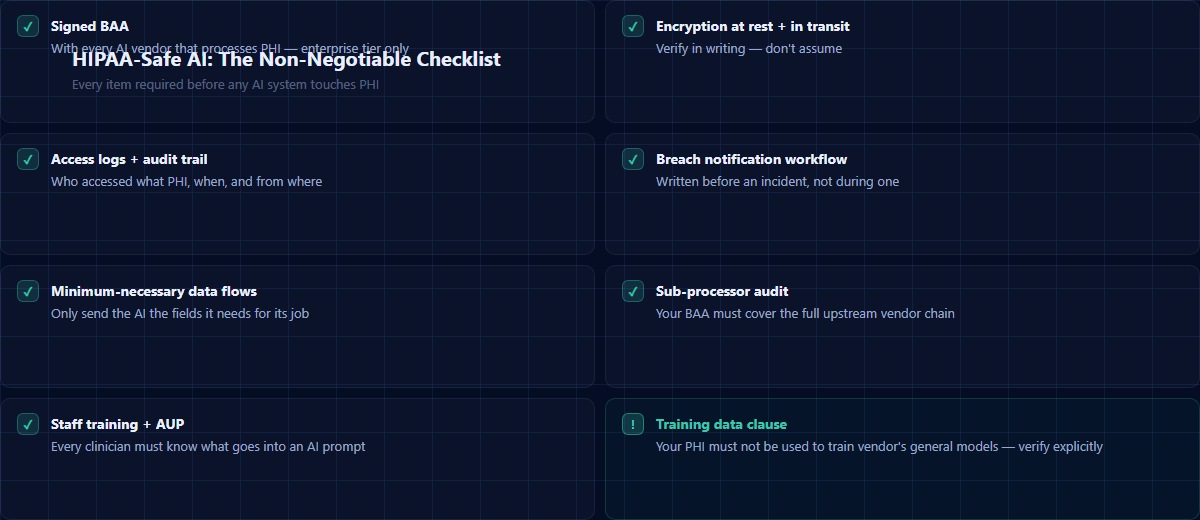
This is the section where most "AI for clinics" articles wave their hands. I'm not going to. If you're going to let any AI system touch protected health information — session notes, demographics, claim data, insurance details, anything that identifies a patient — you need every item on this list before you deploy. No exceptions. HealthIT.gov's HIPAA guidance is the authoritative reference; this is the operational summary.
- Signed Business Associate Agreement (BAA) with every AI vendor that processes PHI. OpenAI, Anthropic, Google, Microsoft all offer BAAs for their enterprise tiers. The free consumer tiers generally do not — use them for non-PHI work only.
- Encryption at rest and in transit for all PHI-adjacent data stores. Verify, don't assume. Ask for the vendor's encryption specification in writing.
- Access logs with audit trail — who accessed what PHI, when, and from where. HIPAA's minimum-necessary principle requires you to be able to prove only-need-to-know access.
- Breach notification workflow that meets the 60-day HHS rule. Most clinics don't have this wired in until the first incident. Write it during onboarding, not during crisis.
- Minimum-necessary data flows — only send the AI the fields it needs to do its job. A session-note summarizer does not need the patient's insurance ID. A billing verifier does not need clinical notes.
- Vendor sub-processor audit — most AI vendors use OpenAI, Anthropic, or a hyperscaler as an upstream. Your BAA has to cover that chain, not just the front-facing vendor.
- Staff training and acceptable-use policy — every clinician needs to know what goes into an AI prompt and what doesn't. One RBT pasting a session note into free ChatGPT is a breach.
A red flag to listen for when vetting a vendor: if they say "we're HIPAA compliant" without offering a BAA and a current SOC 2 Type II report, they are not HIPAA compliant. Walk away. The concrete BAA clause I look for: explicit language covering AI training data handling — that your PHI will not be used to train the vendor's general models, full stop. Most consumer AI tools don't meet this bar. Most enterprise AI tools do.
Patient Communication
AI-powered patient communication systems can handle a wide range of interactions, from answering common questions to providing post-visit follow-up care instructions. The trick in behavioral health and pediatric therapy is that your audience isn't the patient — it's usually the parent or caregiver, and your messaging has to be kid-safe, family-safe, and clinical-culture-safe.
A Communication Cadence That Works for Behavioral Health
Here's a concrete cadence that drives engagement without overwhelming families:
- Day before session: SMS reminder with prep tip ("Bring Marco's snack, he'll have more energy for protocols")
- Morning of session: Text confirm ("Team is ready — reply CANCEL if plans changed")
- Post-session summary (same evening): Brief progress note to parent — "3 targets met today, struggle with transitions, suggest practicing the 'all done' routine at dinner"
- Weekly digest (Sunday): 200-word recap of the week's progress, auto-generated from session notes, parent-language not clinical jargon
- Monthly check-in (calendar-triggered): Parent questionnaire on home generalization
That cadence is not a marketing automation flow. It's a clinical engagement flow, and the difference matters. Parents in pediatric therapy already get too many texts. AI-assisted communication only works if each message is earned — substantive, specific, and tied to real session data. If your AI communication layer generates generic "How was your visit?" texts, you're training parents to ignore you.
Electronic Health Records Integration
Modern clinic software solutions integrate with electronic health records systems, enabling AI to assist with documentation, coding suggestions, and clinical decision support. Good integrations reduce double data entry and ensure information flows between systems. Great ones go a step further — they let you use your EHR as the single source of truth while still getting AI-generated insights on top.
AI can also surface patient risk signals by analyzing data across visits: attendance patterns that predict disengagement, progress plateaus that suggest protocol review, authorization runways that need refilling. This kind of proactive pattern detection is where AI earns its keep. Your EHR has the data. AI turns that data into the right Monday-morning alert for the clinical director.
Decision Framework: What to Automate First in an ABA / Therapy Clinic
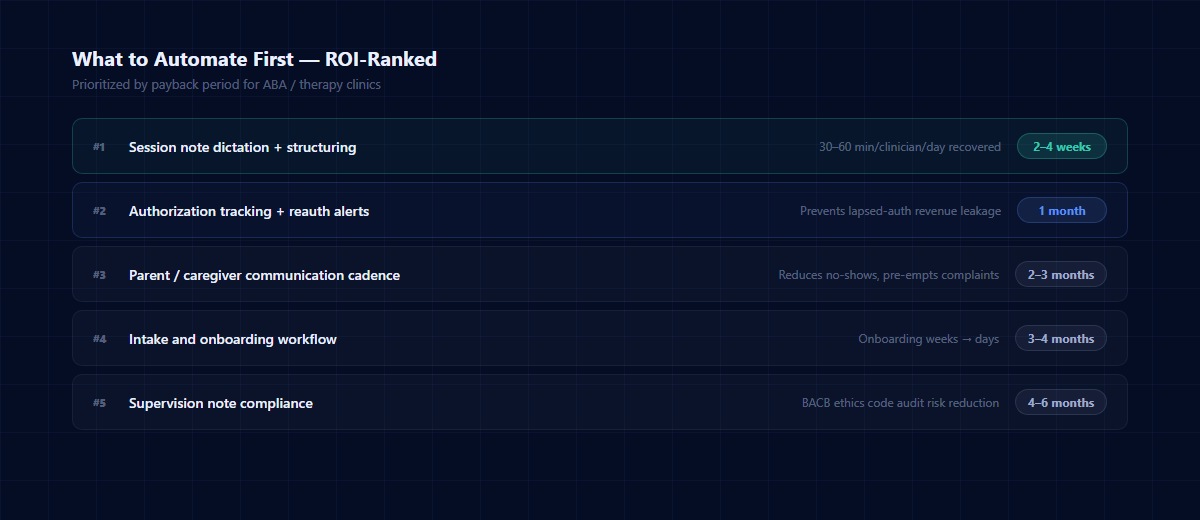
Every clinic owner I work with asks the same question: "Where do I start?" Here's the ranking I'd give, based on a portfolio of automation projects across pediatric therapy, ABA, and adjacent behavioral-health practices. ROI-ranked, with typical payback period:
- Session note dictation + structuring. Payback: 2-4 weeks. Voice-to-structured-notes with HIPAA-safe retention saves 30-60 minutes per clinician per day. Biggest morale lever available.
- Authorization tracking + reauthorization alerts. Payback: 1 month. Prevents lapsed-auth revenue leakage, which is the single biggest silent cost in most clinics.
- Parent/caregiver communication cadence. Payback: 2-3 months. Drives engagement, reduces no-shows, pre-empts parent complaints.
- Intake and onboarding workflow. Payback: 3-4 months. AI-triaged intake forms, auto-verified insurance, scheduled assessments. Reduces onboarding from weeks to days.
- Supervision note compliance. Payback: 4-6 months. AI checks that supervision documentation meets BACB ethics code requirements before submission. Smaller direct dollar impact, but it materially reduces audit risk for the practice.
My advice: pick one. Not all five. The cardinal sin of clinic automation is trying to do everything in month one. Ship one workflow, measure it for four weeks, validate the payback, and only then move to the next. Clinics that automate in sequence win. Clinics that automate in parallel drop the ball across the board and lose staff trust in the tooling within six months.
Choosing the Right Partner and Getting Started
When selecting AI solutions for your clinic, prioritize systems that integrate with your existing EHR and practice management software. The best solutions demonstrate clear ROI through reduced administrative time, improved billing efficiency, or better patient outcomes — and they do so with real numbers from real practices, not case studies that look suspiciously similar to every other vendor's case studies.
Look for partners with actual healthcare domain experience and a strong track record of HIPAA compliance. Data security has to be a top priority, not a bullet on a slide. Ask the hard questions during vetting: Who owns the data? What happens if we switch vendors in two years? What's the incident response SLA? If the answers are vague, so is the compliance posture.
Successful AI implementation in clinics requires careful planning and change management. Start with the one process you identified as highest-ROI in the decision framework above. Measure results rigorously — set a baseline before deploying, track the same metrics weekly for the first quarter. Staff buy-in is crucial; make sure every clinician understands that AI is absorbing their most repetitive tasks, not replacing their judgment. The practices that succeed frame AI as the tool that gives clinicians their afternoons back — because that's what it is when deployed correctly.
Frequently Asked Questions
Is AI HIPAA compliant by default?
No. AI tools are only HIPAA compliant when their vendor offers a signed Business Associate Agreement and the vendor's infrastructure meets HIPAA's technical, administrative, and physical safeguards. Consumer-tier AI tools (free ChatGPT, free Claude, free Gemini) generally are not HIPAA compliant. Enterprise-tier versions of the same tools often are, with the right agreements in place.
Can AI draft session notes that meet insurance audit standards?
Yes, but only when the AI is given the right structure. A note drafted by an AI that follows the payer's exact required fields (behavior definitions, target data, medical necessity language, progress toward goals, supervision documentation if applicable) will pass audit. A note drafted from an open-ended prompt like "summarize this session" usually will not. The structure is the work.
How much does clinic automation typically cost?
Small single-workflow implementations — a session-note drafter, a scheduling AI, a billing verifier — generally land in the $5,000 to $15,000 range for setup plus $300 to $800 per month for operating costs (AI usage + vendor fees). Multi-workflow or fully integrated deployments run $25,000 to $60,000 for setup with $1,500 to $3,500 monthly operating. The payback typically falls within 3-6 months for well-scoped projects. For detailed cost benchmarks across all SMB project types, see our 2026 AI automation cost guide.
How do I get clinician buy-in for AI tools?
Pick the task they hate most. Session-note dictation wins nine times out of ten. Show them the time savings after week one, not week ten. Give them veto power — if they don't trust a generated note, they can regenerate or reject it. Never mandate AI use before the tool has earned it. Clinicians who feel forced into AI tools will sandbag them; clinicians who discover the tool gives them an hour of their life back will champion them internally.
What happens if the AI makes a clinical documentation error?
The clinician is still the responsible party. AI-drafted notes require clinician review and sign-off before they enter the EHR — that's both a regulatory requirement (the clinician is the author of the clinical record) and a quality requirement (AI hallucinations in clinical notes are rare but possible). Build review-before-submit into the workflow from day one. Your compliance posture, and your ONC patient-access rule obligations, depend on it.
Conclusion
AI automation offers real opportunities for clinics to reduce admin burden, free clinician time, and improve both patient and practice outcomes. The clinics that succeed treat automation as a clinician-retention strategy first and a cost-reduction strategy second. They start with one workflow, measure it honestly, and only expand once they've earned internal trust. They take HIPAA seriously from day one — not as a checkbox but as an operating discipline. And they work with partners who have actually sat in a clinician's chair, because the distance between clinical reality and generic SaaS advice is exactly where most automation projects die.
If you're considering clinic automation and want to talk through what would work for your practice, book a free 30-minute consultation. We'll look at your clinical workflows, surface the highest-ROI automation candidates, and tell you honestly whether you need a full custom build or a well-configured off-the-shelf tool.
About the author: Gabriel Jaramillo is the founder of Auth Software and a Board Certified Behavior Analyst. He has 7 years of frontend design and full-stack development experience and actively runs ABA clinical work alongside building AI automation systems for healthcare and small business clients. The clinical automation framework in this article is drawn from his practice and a portfolio of clinic builds across South Florida.
Continue reading
The BCBA's Guide to HIPAA-Compliant ABA Practice Management (2026)
Most ABA agencies assume they're HIPAA compliant because they use CentralReach. They're usually wrong — not about the EHR, but about everything around it. A plain-language breakdown of what HIPAA actually requires for ABA practices, where most agencies have gaps, and how to close them.
AutomationCentralReach vs. Custom ABA Software: When Your Practice Has Outgrown Off-the-Shelf
CentralReach is the dominant EHR in the ABA market for good reason. But there's a specific set of scenarios where it stops being the right choice — and when practices hit those scenarios, they usually don't realize it until they've already built a year's worth of workarounds.
AutomationHow ABA Agencies Are Automating Billing, Intake, and Supervision Tracking with AI (2026)
The average ABA agency running 20 active clients has at least three manual workflows that consume 10–15 hours of admin time per week: authorization renewals, new client intake, and BACB supervision tracking. In 2026, all three are automatable. Most practices haven't automated any of them.